Sunday, September 14, 2014

Europe day 10


Astronomic clock

          During our morning walk we passed by the astronomic clock on the Old Town Hall Tower, one of Europe’s best known tourist attractions.  The mechanism in the clock was refined in 1490, and it apparently has been performing every day since then.  Crowds gather each hour to watch the four figures beside the clock (Death, Vanity, Greed, and Pagan Invasion) and the other figures above it.  On the striking of each hour, Death rings a bell and inverts his hourglass as the twelve Apostles walk past the windows above the clock.  The performance lasts less than a minute, but hundreds of tourists are there to watch it.
 

Just another Prague street along a morning walk


Entrance to Charles Bridge

          We also crossed over the Charles Bridge, commissioned by Charles IV in 1357 to replace a bridge that had been destroyed by floods.  It has lasted more than 600 years, but was not named for Charles until the 1800’s.  makes you wonder why they waited so long to use such a wonderful, historic name.  Since World War II, it has been used for pedestrian traffic only, and the crowds are so thick, you can’t take a decent photo of the structure except from a distance.  30 statues have been erected along the sides of the cobblestone pavement; it’s worth a trip, for sure.


Facade of Dvorak Hall

 The Rudolfinum during intermission

          Later, we attended a morning symphony at Dvorak Hall, named obviously for the famous composer and home to the world-renowned Czech Philharmonic Orchestra since 1946.  Completed in 1885, this Renaissance building houses the Rudolfinum, a magnificent music auditorium.  Here we heard Jan Dusik’s Concerto for Piano and Orchestra in G minor and Mozart’s Symphony No. 38 in D Major, performed by accomplished musicians.  The applause lasted for several minutes.


 Some of the 80,000 Prague Jews executed by the Nazis

          The afternoon was taken up by a visit to the old Jewish Cemetery and grounds in the northwestern part of the old city.  Prague was once the home to 120,000 Jews in a thriving community, but nearly all of them were forcibly removed by the Nazis and 80,000 killed by Hitler’s minions.  Today less than 5,000 Jews live in this city.  But we did notice that here, unlike Istanbul, for example, there are no guards protecting the synagogues and entrance is open to the public.  The cemetery itself holds tens of thousands who were buried peaceably centuries before the German horror.  On the inside walls of a nearby synagogue are inscribed the names, birth dates, and dates of death of every Prague Jew who could be identified as having been killed by the Nazis.  It was a quiet afternoon for our group, one of sadness, anger, and reflection.

Charlie & Tricia
©2014

Europe day 9


           You have been patiently waiting for the history of Prague, so during today’s shopping spree with the ladies, we will give you the information you have been eagerly anticipating:    Wikipedia says it was first populated during the Paleolithic Era—not very precise, because as you well know, that era began 2.6 million years ago and ended at 10,000 B.C.  But at least we know from this tidbit that no people were in Prague more than 2.6 million years ago (perhaps you guessed that).  And since the Paleolithic Era ended at about the same time as the Pleistocene, we can say with some degree of certainty that folks came here before the Mesolithic.

            Perhaps it would have been better to simply say that the place had people in prehistoric times.

 Powder Tower – where the gunpowder was kept

            But the first people we can certainly identify as populating the area were the Celts, who had a settlement here around 200 B.C.  Three hundred years later, Germanic tribes had taken over. But in the great 5th century migration that followed the collapse of the Western Roman Empire, they headed west and in the 6th century, the Slavs moved in.  They’ve been here pretty much since then, in this historical capital of Bohemia.

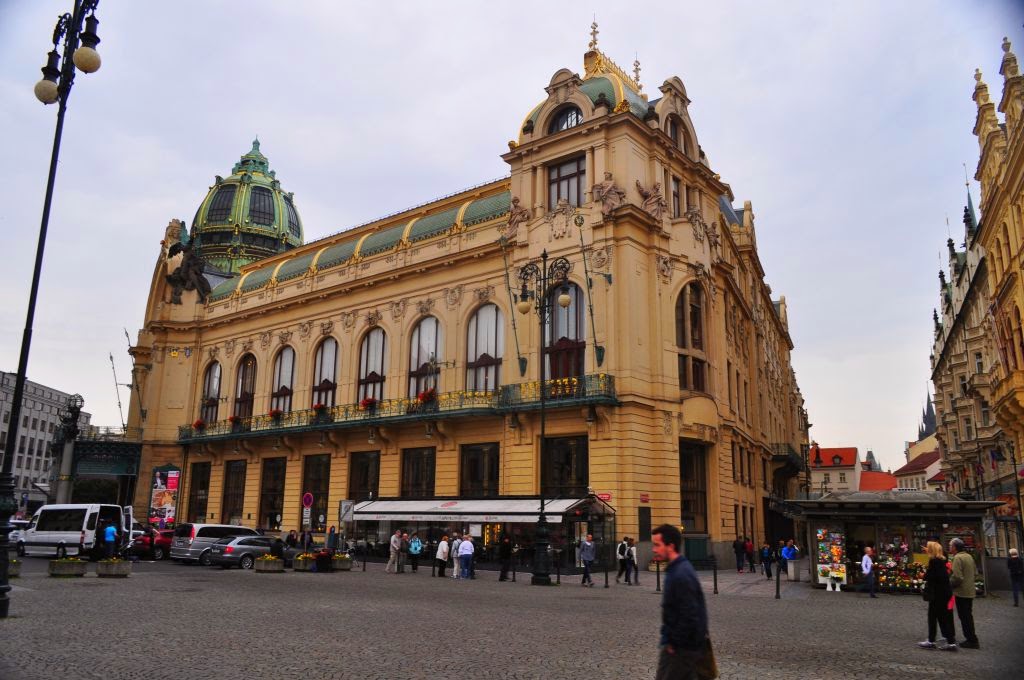
 Municipal house, with Prague’s largest concert hall

          Prague was twice the capital of the Holy Roman Empire, where two separate emperors once lived.   It was also part of the Austro-Hungarian empire, which collapsed in World War I.  It became the capital of Czechoslovakia when that country was created in 1918 at the end of the war. The city played major roles in the Protestant Reformation and the Thirty Years' War.  As for Czechoslovakia, that country existed for much less time than its capital city.  Partially incorporated into Nazi Germany in 1939-45, it fell under Soviet Communist control until the collapse of that evil empire.  Finally, in January 1993, the country was peacefully separated into Slovakia and the Czech Republic, where we now find ourselves.

            We are fortunate that despite all the outside interference and wars over the last thousand years or so, particularly the two World Wars of  the 2oth century, most of Prague’s historic buildings remain undamaged.


 In the Sarah Bernhardt Restaurant

          After a busy day of touring and shopping, we settled down at the Sarah Bernhardt Restaurant in Hotel Paris, just around the corner from  our apartment.  We enjoyed a great meal, accompanied by an accomplished pianist, before sauntering over to the Municipal House, where we were treated to a 2-hour concert by the Karlovy Vary Symphony Orchestra.  This famous orchestra was founded in 1835 and is still based in the spa town of Karlovy Vary, with a current population of under 50,000.  To assemble such a group of musicians from such a town tells a great deal about the emphasis on the arts in this corner of Europe.  We watched and listened to Bruch’s Violin Concerto No. 1 in G Minor, Grieg’s Piano Concerto in A Minor, and Dvorak’s Symphony No. 9 in E Minor.  It was a wonderful ending to an active day.

 Smetana Hall in the Municipal House

          By the way, during our wandering today, we had a glass of Budweiser beer.  Not the Budweiser you know, but the original Budweiser, which has been brewed since the 14th century in the Czech town of Ceske Budejovice.  A dispute has raged for more than 100 years over the right to use the name, German immigrant Augustus Busch having begun its use in America in 1876 because it reminded him of his old country.

          And one of us enjoyed a scoop of gingerbread and a scoop of strudel to keep his mind off all the shopping his wife was doing.

Charlie & Tricia
©2014

Friday, September 12, 2014

Europe day 8


            On an overcast, drizzly day we set out by car with guide Krysti to the medieval town of Kutná Hora, which sprang up in the 13th century when silver was discovered in the area.  The boom town soon became one of the largest cities in Europe, with even a mint established to convert the massive amounts of silver into coins.  But after the mines began to dry up 300 or so years later, the Thirty Years War and the great fire of 1770, it pretty much faded away.  The massive cathedrals which were built with the miners’ money endured, and they are worth a trip.  Under communism there wasn’t much in the way of tourism, but in the past few years the place has blossomed.

 Cathedral of St. Barbara

View from part of one side

Ceiling 200 feet up

            We began our tour of the town with the massive Gothic Cathedral of St. Barbara, begun in 1380, interrupted by the Hussite Wars, and abandoned in 1558 when the mines could no longer support it.  The end of the 19th century finally saw its completion.  While we wandered the grounds and went inside the church, we talked about the Hussite Wars, which you may know as the Bohemian Wars (after all, this entire area is known as Bohemia).  Back in those days, people were killing each other left and right in the name of religion.  In this case, the war was between the precursors of the Protestants and the Catholics.  We thought of other wars, tortures, and killings performed in the name of religion, and were thankful that we have all become so much more civilized now, and killing for God has become so passe  . . . it has, hasn’t it?


Inside the Church of St. James

            After passing by a huge former Jesuit monastery now used as an art gallery, our next stop was the older and almost equally impressive Church of St. James, completed in 1420.  The 270-foot tower is visible for miles, and while we were inside, we were treated to music from the great organ.  Someone was perhaps practicing for a concert, because almost no one attends church anymore in the Czech Republic.  In fact, the country is known as the most atheistic nation in Europe.    Krysti said in her 20-plus years in Prague, she does not know a single person who practices a religion.  These UNESCO sites are preserved for their historical and architectural value, and no longer serve much of a religious purpose.  You can decide whether all the wars, including the one during your lifetime, had anything to do with that.

 Part of one pyramid of bones in the ossuary

            The last stop of the day was certainly the most unusual.  The Sedlec Ossuary is a cemetery where the 30,000 burials had left no room for more, so in 1870 all the bones in the crypt were put on public display, creatively arranged by a local woodcarver into 4 pyramids and assorted wall and ceiling decorations.  The strangest of all is a skulls-and-bones chandelier hanging among the pyramids.


 The great chandelier

            We had to wait several hours after the last visit for our appetites to return, so we had a late meal before retiring.  We even forgot to look for an ice cream shop.
           
Charlie & Tricia
©2014

Thursday, September 11, 2014

Europe day 7


            Characterized by some as the most beautiful city in the world, Prague is certainly one of the most beautiful we have ever experienced.  Hal and Millie Weathers back home had recommended as a tour guide a former high school friend from Macon, Georgia, former CPA and investment banker Krysti Brice, who has lived here more than 20 years.  Krysti loved Prague so much she quit her job and now calls it home.  We roamed the streets with her, learning about the history and architecture of the place, until we could absorb no more.  It was overwhelming.  For this first full day, we will simply share the photos with you, and suggest you just click on the first one so you’ll be able to scroll through the larger versions:


 Ceiling in our restaurant at lunch

        Taking all this in took a great deal of energy, of course.  We couldn't have done it without a quick stop at Prague's finest ice cream shop.  You would have been proud of my self-restraint; I only ordered one scoop of the jasmine rice and cinnamon flavor.  It was exquisite.  The cinnamon did not overpower the jasmine rice, which would have happened in a lesser shop.  Kristi, Tricia, and Viren went over the top and had among themselves the following flavors:  pistachio, poppy seeds & plum,  pear & ginger, marscapone & wild fig, and  gianduja (chocolate and hazelnut).  Only upon their insistence did I sample a bit of each of these flavors.

        What a city!

With Krysti and Viren at Angelato


 Charlie & Tricia
©2014